Monday, July 2, 2012

Project: Three Keys

Name: Three Keys
Size: Size 5, Double Fold
Cover: Leather Cover
Cover Material: Black Leather
Pages: 600 (approximately)
Paper: 75 lb
Elements: Two buckles on cover flap, book ribbon,
Estimated Value: $100.00

Description: A size 5, double-fold journal with a depressed design of a pentagram and three skeleton keys on the outer cover.

Discussion: 

So I need to create an image of a pentagram with three skeleton keys at the base. 

This will fit onto the front cover of the book as a recessed image (where the image is sunk into the cover board)

The whole book will be closed and sealed with a flap on the back cover and two brass buckles to hold it closed as I did earlier with the Paladrym.


So when it's finally finished the book will look something like this: (with a black cover)


Update: 6:25.12

Work and finding an alternative source for grey board has taken it's toll and I was only recently able to finish the body of the book. I still have yet to mount the buckles and straps on the cover but I am going to show it to the client tomorrow to get his input for where he wants them.

I forgot how labor-intensive double-folds can be. :)

Pics to come.

Update: 5.30.12
I've finished the exterior cover for the book - the shaded areas will be carved out in the next day or so.


Update: 5.29.12

Secured enough grey board for the cover and have sewn up the secondary book. Now all I have to do is layout and carve the symbol, build the buckles and start assembly.  


 Update: 7.2.12

DONE.

I've delivered the 3-Keys to its new owner who has promised that he will tell me the Book's name when it's revealed.


Tuesday, June 12, 2012

Design: Owl Spine


I've always wondered about adding a design to a book that wrapped around the entire cover. I remember seeing some journal cover a while back that had a large Celtic tree that was centered along the spine. I thought that I could do the same thing.

 The cross-hatching in the background would require a fine-bladed wood burning tool to keep it from looking too 'mushed' I would think.

To wrap around a journal of dyed pages of mixed colors (green and brown) I thought about making an Autumn-themed book and I wanted to include my new 'spine-animal' design.
I would probably use a tie-closure for this design.


Design: Serpent-Cup

Over and over again I am trying to add symbols for book-cover designs. I think the above design was made years ago and I've still not put it on a book.

The symbolic elements are:

Snakes entertwined: Snake = Rebirth, Regrowth. Knotted = Bound, connected, etc.

Cup = Female. Life. (Holy Grail-ish), Plenty, etc.

Sun/Moon = Balance between male and female.

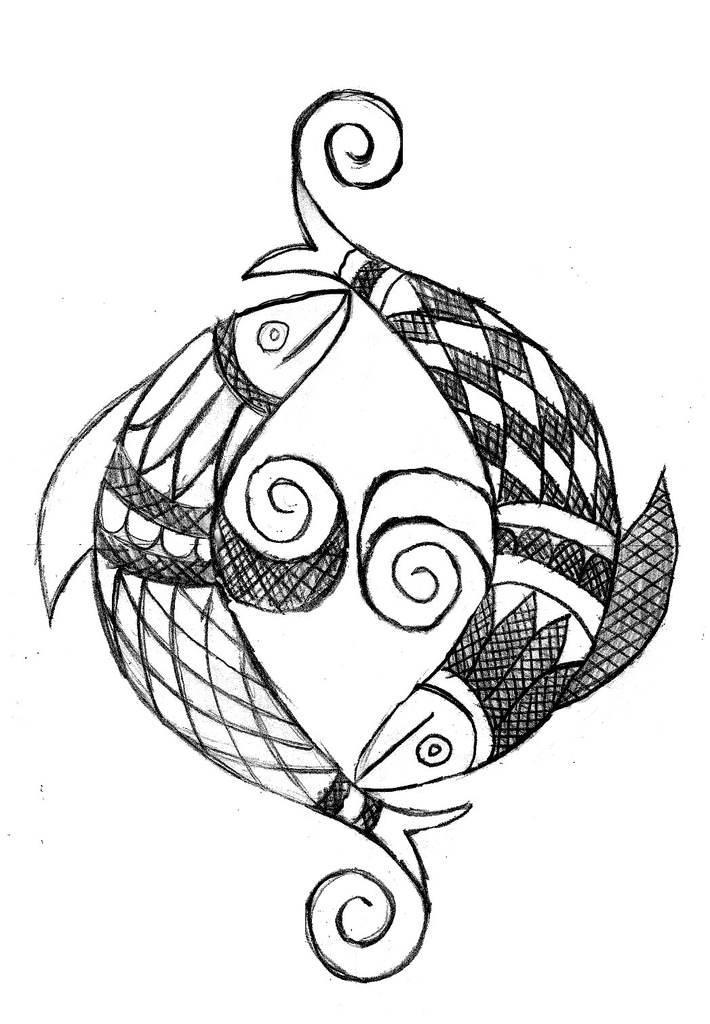
Design: Fish Yang


A friend of mine once asked if I could make a yin-yang symbol out of fishes. Don't ask - it's complicated.

I think this design would be great as presswork into a leather journal using additional dye to bring out the darker portions.


Update: 5/13/13
This design was put on a ledger-sized, all-leather book cover. (Click Here)

Design: Moon Wheel


This is a design that I've done over and over again as a possible cover for a book. I think that I would either press the design into the leather and then color it with dye to bring out the lines and different phases of the moon.

The only problem with the design is that it really needs something at its center. I could always put in a tripple-moon or a pentacle or something depending on what the client wants.

Friday, June 1, 2012

Newsboard

Newsboard is a form of compressed cardboard often made from recycled newsprint (thus the name). it is commonly used in matting pictures, mounting or backing artwork, etc.

I use it for the covers of my books as it's affordable and easy to work with since it comes in 1/4th inch thickness.

However - my main supplier has "chosen" not to carry it any longer so I'm on the hunt for a new source. Unfortunately I have several projects that require a lot of it (double folds take 3 boards alone).

More when I find a better source.
-Tom

Sunday, May 27, 2012

Book: Green Scale Brick

Name: Green Scale Brick
Size: Size 1, Brick
Cover: All Leather
Pages: 500 (approxi)
Paper: 75 lb
Estimated Value: $20.00
Description: The Green Scale Brick is an all-leather cover, size 1, "Brick" journal with a tie closure and press work and leather dye elements.

Process:

Bricks are one of the easier journals for me to make and the design is something that I use for experimentation in covers. There's not a lot of cover material in a size 1 journal so I can afford to try new stuff. the different between a size 1 journal and a 'brick' is the number of pages. Bricks will have double the number of pages for an average size journal. For this project the pages are 75 lb, heavy weight 'construction paper' that takes ink, charcoal and paint very well.

Once I had the book block (the bound section of pages) finished and dressed (the edges were cut and the spine rounded), I cut out a piece of 2-3 ounce Craftsman Tooling Leather (from Tandy Leather) and started to lay out the basic space I would have to experiment within.

The design for this book started with a simple, quarter-inch border around the cover. It creates a 'framework' in which I can plug any design I want. Once I had the border lined, I added small dots with one of my leather stamps to break up the empty space of the border.

Then I wanted to get into some cross-hatching for the cover and see what would the effect be with such thin leather.

As you can see, Bricks are wide books. This one measure around 2 inches thick.

Normally I use 3-4 ounce leather for my books but wanted to try something thinner to see what would happen. Once the grid was put onto the cover and pressed, I started work on the dye process.

Leather dying is a pain. It's the one 'random' factor in making a book that I'm still working on. For this project I wanted to see if I could marble the leather to give it a mottled, lizard-like quality and I think I've achieved it. I left the outer edge the base 'green' color that I used as a reference for what I had to start with when I began altering the colors of the main body.

Once I had the cover dyed and marbled the way I liked it, I added a simple, string closure (mainly because anything too thick would stand out along the center of the book so I kept it thin) that one could tie closed.

For end-papers, I'm experimenting with marbling colored paper. I think it looks need and is kind of cool for a green-covered book.


Saturday, May 26, 2012

Wicker Tree Symbol


 So I was  at Walmart and saw a DVD title that caught my attention: The Wicker Tree. It is the sequel to the original Wicker Man movie back in the 1970's with Christopher Lee. The symbol on the front of the DVD cover caught my attention as an interesting combination of the sun-and-face design along with a pentacle.


So I decided to do a search for the image and found something that I could start with. I didn't want to use their versions because it's full of inverted crosses and that's hard to do as background filler in presswork for a leather journal.

I sketched out half of the design (since I would simply duplicate that half to make the whole) and scanned it in. When I combined the two halves together it made a weird... crown-ish design at the top. The wavey sun-rays should spiral around the sun in the same direction (and I planned on fixing that) but the image with the central 'crown' thing just looked interesting.


But I still wanted to see what the image looked like with the radial sun-bursts going in the right direction so I fixed it and decided to add some color for the wavy lines. In the finished design for the book, I'll simply press the entire shaded area and dye it darker.
But - since the book would not be white I wanted to see what the black on stained-leather would look like and knocked together a quick representation of the different looks.


I'll post finished progress pics once I start working on it.

Tuesday, May 1, 2012

Term: Double Fold

Name: Double Fold
Size: varies but often Size 5
Cover: Leather or All Leather
Pages: 600 (approximately)
Paper: 75 lb
Elements: Varies but often will include Decorative Symbol (Raised or Recessed), Book Ribbons, Buckle closures, etc.
Estimated Value: $50.00 

A Double-Fold book is essentially two books bound within the same cover. Books such as these have been used for a myriad of purposes but were popularized in the movie, Practical Magic, as a Book of Spells. One of the books was for the 'good' spells and the other was for the 'bad' spells.

Double-Folds can be of almost any size (1-5) but are commonly made 'big' (size 5) because people wish to pour plenty of work into each page and need the additional space. Some have opted for a smaller version and gone with a smaller size but that is a matter of personal preference.

When designing a double-fold book there are a lot of terms and elements that need to be discussed (the cover material, any design that might be added and upon what cover will it go, etc.).

To make things easier for those people who want me to make them such a book I've tried to keep the terms fairly simple.

The cover for a double-fold is much larger than a standard book as it has to wrap around two separate blocks of pages. 
 It's important to note where a client wants a symbol or image place so that mistakes aren't made in the construction process. Additionally - images on the Interior covers have to be RECESSED as opposed to RAISED because the raised image will press into the pages of the Primary Book.

Double Fold books are divided into two sections: the Primary Book and the Secondary Book. The Primary book is usually the thicker of the two sections (usually 2/3rds of the total pages) and is the book  that one first sees when they open the book. The Secondary book is often thinner or equal to the Primary book (the distribution of the pages can be equal - it's a matter of the client's wishes) and is often where the author will keep 'reserved' information.

In the case where books such as these were used by the medical profession in the 16th and 17th century, the Secondary book was a book of known cures; things that the physician knew worked as treatments for various maladies. Essentially the Secondary book was the 'Physician's Desk Reference' of the time. The Primary Book was a written record of all of the cases that he had come across in his work. It would most closely be associated with a the charts and medical histories kept by the medical profession on their patients.

For my "Standard Double-Fold" I will often encourage the client to pick a symbol for the Exterior cover of the book - something that's meaningful to them. Normally I will try and keep the design down to an inch-shorter than the dimensions of the exterior cover. So an 8.5" x 11" cover would have a design space of 7.5" x 10". It's just easier to fit the design into the space allotted.

The only problem is when someone wants to add buckles to the book - the design space will shrink as the buckles attach to the Exterior Cover in two or three places and that can either A) shrink the design to near obscurity or B) move the design to the Interior cover.

Other binders or book suppliers charge STUPID amounts of money for their versions of Double-Fold books.

Studio Lapulia: $635.00

Term: Raised Design

A design element often used in leather or all-leather book covers.
The image is pushed  up from the surface of the book making it thicker.

Thursday, March 29, 2012

Book Sizes

Scale of the American Library Association

Size NameSymbolOutside Height*Appx Size in Inches*
folioFover 30 cm12 x 19
quartoQ25-30 cm9½ x 12
octavoO20-25 cm6 x 9
   imperial octavoO-8¼ x 11½
   super octavoO-7 x 11
   royal octavoO-6½ x 10
   medium octavoO-6 1/8 x 9¼
   crown octavoO-5 3/8 x 8
duodecimoD17.5-20 cm5 x 7 3/8
duodecimo (large)D17.5-20 cm5½ x 7½
sextodecimoS15-17.5 cm4 x 6¾
octodecimoT12.5-15 cm4 x 6½
trigesimo-segundoTt10-12.5 cm3½ x 5½
quadrasegisimo-octavoFe7.5-10 cm2½ x 4
sexagesimo-quartoSfless than 7.5 cm2 x 3
*Outside height refers to the head-to-foot dimension of the book's cover
*Approximate Size refers to the front cover's rectangular dimensions

The common book-trade designation of sizes was originally related to a sheet of handmade paper measuring 19 X 25 inches, which was the common size of the papermaking mold. When folded to 8 leaves, or 16 pages, and trimmed, each was 6½ X 9¼ inches, approximately, and was the standard dimension of an 8vo. When folded to make 16 leaves, or 32 pages, it was a 16 mo. With the present great variety of paper sizes, all dimensions are by necessity only approximate. (52, 69, 140, 156, 169) 

British book sizes

Size NameOctavo SizeQuarto Size
pott 6¼ by 4 8 by 6¼
foolscap 6¾ by 4¼ 8¼ by 6¾
crown 7½ by 5 1O by 7½
large crown 8 by 5¼ 10½ by 8
large post 8¼ by 5¼ 10¼ by 8¼
demy 8¾ by 5 5/8 11¼ by 8¾
post 8 by 5 10 by 8
small demy 8½ by 5 5/8 11¼ by 8½
medium 9 by 5¾ 11½ by 9
small royal 9¼ by 6 1/8 12¼ by 9¼
royal 10 by 6¼ 12½ by 10
super royal 10¼ by 6¾ 13½ by 10¼
imperial 11 by 7½ 15 by 11

Tuesday, March 27, 2012

PROP: Victor Frankenstein's Journal

From Mary Shelley's Frankenstein

Dimensions: 8 x 10 x 1.5
Cover: Leather with stamped initial.
Closure: Frog-Tie (wooden bead and loop)

I've been trying to find some good screen-caps of the journal of the main character of Mary Shelley's Frankenstein for years so I finally grabbed some on my own.


The pages look to be of a thick, good quality that have been ripped on the edges as though from a larger sheet. A common practice for books at that time period.

The journal is held together by a pair of frog-ties on the front cover. The frogs (the things that are used to fit within the loop on the back cover) appear to be little more than just a wooden or ceramic bead that's held in place on a thin cord.


The big question for the book is to figure out its dimensions. Usually I'm able to gauge the size of a prop (a book prop) is to get a shot of someone holding the book and extrapolate the height and width based on the breadth of the person's hand. Usually, the breadth of a man's hand is between 3 and 3.5 inches wide.

So if I can assume that the actor's hand is a close approximation to the standard, then I can deduce that the book is about 9 or 10 inches high. So it's just slightly smaller than a standard piece of paper (8.5 x 11 inches).

So then I looked at the width of the book and I would guess that it's about 8 inches wide based on the observation that the actor's knuckles (usually 4-5 inches across since they're thicker than the fingers) cover about half of the cover in the screen-cap below.
I then was able to notice that the spine of the book, though it is a leather cover, is marked with several ridges as though the cords of the spine were showing through. This would suggest that the book block (the actual pages) has five cords.

I can't see any headbands / footbands on the edge of the journal so it's not impossible that the binder didn't use them. For journals like this it would not be uncoming to leave that element off as it would make it more difficult to unbind the pages later.


Simple, leather-covered journals like this would often be unbound and all of the 'good' pages (as opposed to all of the scribbles and doodles that were basically worthless) could be rebound in another book.
The journal's cover shows the frog-tie closure as well as a large 'V' within a circle that appears to be either burned or stamped into the leather.


BOOK: Burnt-Paper Cover

This is a paper-covered book that I added small bits of scorched paper as a decorative element. The spine of the book was covered in leather. I made it small - as an experiment to see if I liked the burnt-paper look - so it's only the size of a "Brick".

The book was created in the summer of 2011.

BOOK: Paper-Covered Book

This was a standard, 'brick' that I covered with decorative "scrap booking" paper and used a complimentary-colored paper for the spine.

The book was completed in Summer 2011

COVER: Leather Journal Cover


Occasionaly I will make some leather covers for a pre-bound journal. I'm a sucker for those black-covered sketchbooks that you can find at almost any art-supply store. I use them for everything. A while back I took some leather and built a wrap-around cover for them (so I can just pull a full journal and replace it with another, blank one) and added a long, leather tie and a small fob in the shape of a fly that I made out of FIMO clay.


TERM: Cover

See also:

Cloth Cover
Half-Cover
Leather Cover
Leather Spine
Paper Spine
Paper Cover

TERM: Closure

See also:

Leather Tie
Frog Tie
Buckle
Peg and Loop

TERM: Frog-Tie


Monday, January 23, 2012

PROJECT: Orville Wright's Diary

DIMENSIONS: 3.5 x 8
COVER: Cardboard
PAGES: 30


This is Orville Wright's Diary. The diary that he documented the famous, first flight and most of the days leading up to it.

When I ran across it for another project I was interested in its odd dimensions and decided to dig into how it was made.

This style of journal or notebook was an odd-sized because they were designed to fit into the breast pocket of a jacket. Occasionally referred to as a 'Jacket Journal' or 'Pocket Diary' the pages were either lined or graph.

I picked this image of Orville's diary from a wiki page and started counting squares to get an idea of how big it would have been.

Since graph paper usually comes either four squares to the inch or five, I calculated the dimensions based on the larger of the two. On my best guess, the journal is 3.5 inches wide and eight inches long. I would guess that the cover was some form of card stock or thick paper cover. I couldn't find a good picture of the cover but I'm sure there's probably more photographs out there with the Smithsonian.

Based on a closer examination of the spine - the pages are stitched together but it's probably stitched in a block (like a composition notebook) rather than in gathers or choirs.

The pages have been rounded so that they don't get damaged while constantly being stuffed into a jacket pocket.

The pages number up to 58 as far as I've seen. There could be thirty pages (doubled to make 60) or fifty pages (doubled to 100) but it's not certain. Fifty pages would create a journal that's around a quarter inch thick (without covers).

The journal would seem to be a perfect design to capture the notes of the day or whatever important lists that one might have.

I should probably try and make one.

Friday, October 28, 2011

BOOK: Wedding Album


This is a wedding album I made for some friends using a variety of techniques. This was mostly an experimental project as they weren't too specific about what they wanted so I tried a few new ideas.

1. The idea of creating a 'window' for a photograph at the front of the book had gotten my attention a while back but the design element practically screams "photo album". I created the raised border using grey-board and added a layer of thin, brown paper over it to remove some of the 'seams'.

2. I used a Half-Cover bind with leather corners and spine since I was running out of leather.

3. I wanted to try a 'window in a window' or 'border inside of a border' design element where the outside of the book has a raised border and then another border set inside the edge. I think it really brings some interesting design elements to the cover of the book but will have to fiddle with how I use it on future projects.