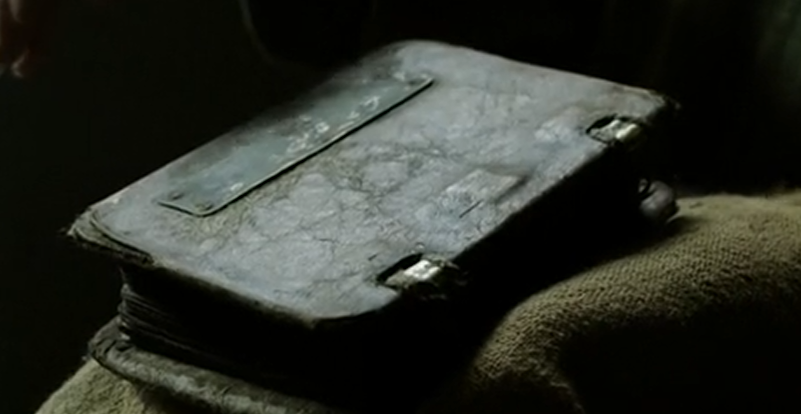
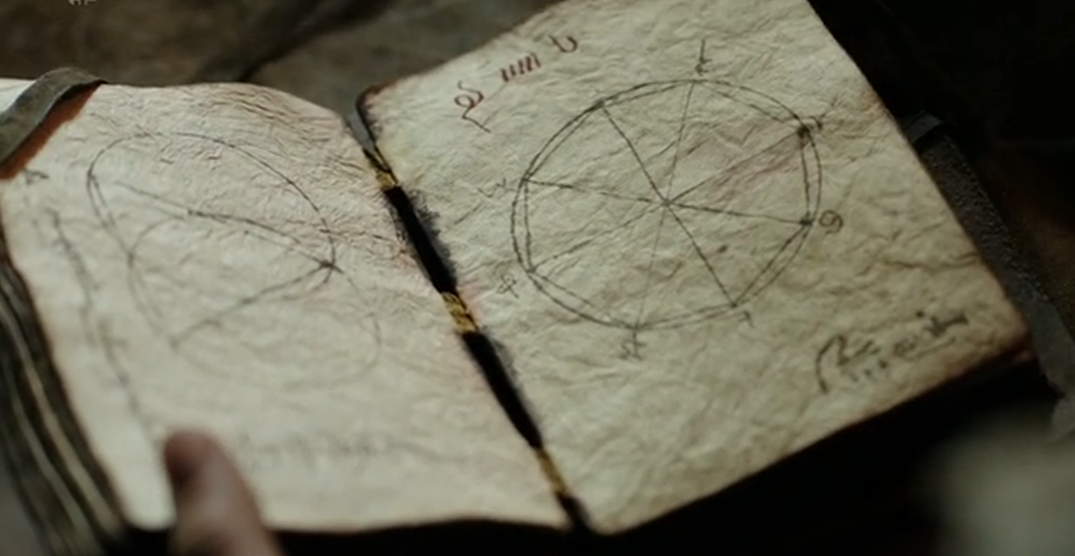
From the movie: Hansel and Gretel, the prop is a book of protection versus dark magic.
It's an interesting design in that it combines multiple elements.
1. Raised Designs - the skeletonized bodies of two reptiles have been tied or anchored to the front covers of the book.
2. Two separate book blocks with a single, shared spine.
3. Over accentuated spines that seem to serve as support posts for the book when fully opened.
4. The pages seem to be tied together loosely and then somehow bound to the book.
Showing posts with label Prop. Show all posts
Sunday, May 26, 2013
Prop: Abramelin's Grimoire (Hansel & Gretel: The Witch Hunters)
Monday, May 20, 2013
Prop: Abraham Lincoln Journal
From the movie, Abraham Lincoln: Vampire Hunter.
This is an all-leather covered journal that appears to be somewhere around a size-2 book with a leather tongue on the back cover and a loop on the front with a small pencil loop inside.
Labels:
All-Leather Cover,
Journals in Media,
Prop,
Size 2 Book,
Slot-Tab
Monday, April 1, 2013
Game of Throne Props
The wax-melting cup (it was difficult to get screen-shots of it since it was mostly a blurry shape in the foreground of the scene) appears to be simply a small cup with a pouring handle that's sitting upon a simple base. The base with its three posts keep the cup elevated above a burning candle which is used to heat the sealing wax.
It appears as though the candle is kept short enough so that the flame is just brushing against the bottom of the cup. Logic would suggest that when you're done sealing whatever letter or document you have you just blow out the candle and allow the wax to cool in the cup. In this manner any scrap bits of sealing wax could be tossed back into the cup to be melted when needed next.It's a brilliantly simple design that I would love to replicate.
Step 1: Find a sturdy, metallic cup with a handle that I can use as a melting cup.
Step 2: Find some kind of base that would kept the cup above the flame.
I think that I should be able to use a soap stone oil burner for the base as it's already designed to heat up a substance with a candle. I would just need to find a model that allowed me to remove the cup at the top - or replace it with a suitable metal cup with a handle.
I now understand why desks were so large in this supposed era - you had so many trinkets and gadgets to use to write a letter that you needed all the space to keep it all straight and in order.
![]() |
| This would be perfect if I could just find a version that has a removable top. |
![]() |
| a 1/4th cup, metal measuring cup and a coffee-cup warmer does the trick nicely. |
Books from Labyrinth
A new movie caught my attention called Labyrinth based on the series of books by Kate Mosse.
In the two-part series they reference three books that have something to do with the Holy Grail.
I didn't quite pick up on what the books were about save for their titles:
The Book of Numbers
The Book of Potions
and The Book of Words.
Below I've attached screen-caps from the movie of the first two books (the book of words was only shown in wrappings at the end).
It appears as though the book of potions is a coptic-style book where the pages are sewn to each other and then to a cover. The book of numbers, however, appears to a period bind from around the 1200's when the movie was set.
![]() |
| Cover of Book of Numbers |
![]() |
| Cover of Book of Potions |
![]() |
| Internal shot, Book of Numbers |
![]() |
| Cover of Book of Numbers with what appears to be leather straps for tapes. |
![]() |
| Spine of Book of Potions - notice the tied cords. |
![]() |
| Cover of Book of Potions, notice what appears to be a metal plate on the cover as decoration as well as the hidden cords on the spine. |
![]() |
| More detail on the cover of the Book of Potions. |
![]() |
| Scan from one of the pages of the Book of Potions. |
Labels:
All-Leather Cover,
Leather Cover,
Prop,
Size 2 Book
Tuesday, March 27, 2012
PROP: Victor Frankenstein's Journal
From Mary Shelley's Frankenstein
Dimensions: 8 x 10 x 1.5
Cover: Leather with stamped initial.
Closure: Frog-Tie (wooden bead and loop)
I've been trying to find some good screen-caps of the journal of the main character of Mary Shelley's Frankenstein for years so I finally grabbed some on my own.

The pages look to be of a thick, good quality that have been ripped on the edges as though from a larger sheet. A common practice for books at that time period.
The journal is held together by a pair of frog-ties on the front cover. The frogs (the things that are used to fit within the loop on the back cover) appear to be little more than just a wooden or ceramic bead that's held in place on a thin cord.

The big question for the book is to figure out its dimensions. Usually I'm able to gauge the size of a prop (a book prop) is to get a shot of someone holding the book and extrapolate the height and width based on the breadth of the person's hand. Usually, the breadth of a man's hand is between 3 and 3.5 inches wide.
So if I can assume that the actor's hand is a close approximation to the standard, then I can deduce that the book is about 9 or 10 inches high. So it's just slightly smaller than a standard piece of paper (8.5 x 11 inches).
So then I looked at the width of the book and I would guess that it's about 8 inches wide based on the observation that the actor's knuckles (usually 4-5 inches across since they're thicker than the fingers) cover about half of the cover in the screen-cap below.
I then was able to notice that the spine of the book, though it is a leather cover, is marked with several ridges as though the cords of the spine were showing through. This would suggest that the book block (the actual pages) has five cords.
I can't see any headbands / footbands on the edge of the journal so it's not impossible that the binder didn't use them. For journals like this it would not be uncoming to leave that element off as it would make it more difficult to unbind the pages later.

Simple, leather-covered journals like this would often be unbound and all of the 'good' pages (as opposed to all of the scribbles and doodles that were basically worthless) could be rebound in another book.
The journal's cover shows the frog-tie closure as well as a large 'V' within a circle that appears to be either burned or stamped into the leather.
Dimensions: 8 x 10 x 1.5
Cover: Leather with stamped initial.
Closure: Frog-Tie (wooden bead and loop)
I've been trying to find some good screen-caps of the journal of the main character of Mary Shelley's Frankenstein for years so I finally grabbed some on my own.

The pages look to be of a thick, good quality that have been ripped on the edges as though from a larger sheet. A common practice for books at that time period.
The journal is held together by a pair of frog-ties on the front cover. The frogs (the things that are used to fit within the loop on the back cover) appear to be little more than just a wooden or ceramic bead that's held in place on a thin cord.
The big question for the book is to figure out its dimensions. Usually I'm able to gauge the size of a prop (a book prop) is to get a shot of someone holding the book and extrapolate the height and width based on the breadth of the person's hand. Usually, the breadth of a man's hand is between 3 and 3.5 inches wide.
So if I can assume that the actor's hand is a close approximation to the standard, then I can deduce that the book is about 9 or 10 inches high. So it's just slightly smaller than a standard piece of paper (8.5 x 11 inches).
So then I looked at the width of the book and I would guess that it's about 8 inches wide based on the observation that the actor's knuckles (usually 4-5 inches across since they're thicker than the fingers) cover about half of the cover in the screen-cap below.
I then was able to notice that the spine of the book, though it is a leather cover, is marked with several ridges as though the cords of the spine were showing through. This would suggest that the book block (the actual pages) has five cords.
I can't see any headbands / footbands on the edge of the journal so it's not impossible that the binder didn't use them. For journals like this it would not be uncoming to leave that element off as it would make it more difficult to unbind the pages later.
Simple, leather-covered journals like this would often be unbound and all of the 'good' pages (as opposed to all of the scribbles and doodles that were basically worthless) could be rebound in another book.
The journal's cover shows the frog-tie closure as well as a large 'V' within a circle that appears to be either burned or stamped into the leather.
Labels:
Frog Tie,
Journals in Media,
Leather Cover,
Prop,
Recessed Design
Wednesday, July 6, 2011
PROP: 20,000 Leagues Under the Sea Journal
Ok, so I have been reading up on the Jules Verne style of the old Steam-Pulp stories. When I got a copy of the movie I saw that there was something unique in the props for the character of the Professor; his journal.

Immediately I sprang to work on tearing apart how it's made. Like an arrow from a bow, I snagged some screen shots and thanks to some Photoshop work I think they're clear enough I can tear apart the design.
The first thing that I saw was that it has a snap closure on a flap that folds over the journal's cover; not an uncommon feature since you want to protect the pages and such.

The left cover, apparently wooden, is longer than the pages by almost six to seven inches. This extra width in the board to cover not only the pages but also the small 'box' that's attached to the rear board.
This 'box' is designed to hold ink wells and dip pens - the most common writing medium of the film's period. I have a better picture of what the box looks like below but for now let's concentrate on how the designer has incorporated it into the cover.
Two hinged flaps extend from the head and the foot of the rear cover that can fold over the box presumably to protect it from wear and tear.
The two flaps, somewhat shown here in a capture that I tried to blow up large enough to see, just fold over the 'box' or 'tray' of writing materials and the actual closure flap would close off the third side with the paper covering the fourth.
The character of the professor is shown opening the head and foot flaps so that he can access the ink wells and dip pens in the open box / tray inside.
The pages of the journal almost look like they're stab-bound. A stab-bound journal would seem to make sense since you're basically writing things in it that will be pulled out and later organized into whatever research you're working on. I would almost say that this design of journal is more like a captain's log.

This is the good shot of what the inside of the journal looks like. The writing tray has the two ink wells and a few dip pens for writing. You can clearly see the tab that extends out of the head of the rear cover as well as the closure flap that would close over the front board.
I like that in this case, they covered the tabs with some marbled paper and the tray is apparently felted.
Labels:
Journals in Media,
Process,
Prop,
Stab-Bind
Subscribe to:
Posts (Atom)